
Peru Power Plug: Plug Types, 220V Voltage and What US Travelers Need
By the Goo Machu Picchu team · Checked against official sources (editorial policy) · Updated October 2026 · 6 min read
Peru power plugs are Type A (two flat pins, like the US) and Type C (two round pins), and the supply is 220 volts at 60 Hz. Most US two-prong plugs fit, but the voltage is nearly double the US 110 to 120 volts. Phones and laptops handle it; many hair dryers and straighteners do not.
This guide covers only electricity for your trip: which outlets you will see, what 220V means for US devices, how to read a dual-voltage label, when an adapter or converter is needed, what to pack, and how charging works on treks, trains and Amazon lodges.
- Plug types
- Type A and Type C
- Voltage
- 220 V
- Frequency
- 60 Hz (same as the US)
- US two-flat-pin plugs
- Usually fit
- US three-prong plugs
- Need an adapter
- Converter needed
- Only for single-voltage 110 V devices
What Type of Power Plug Is Used in Peru?
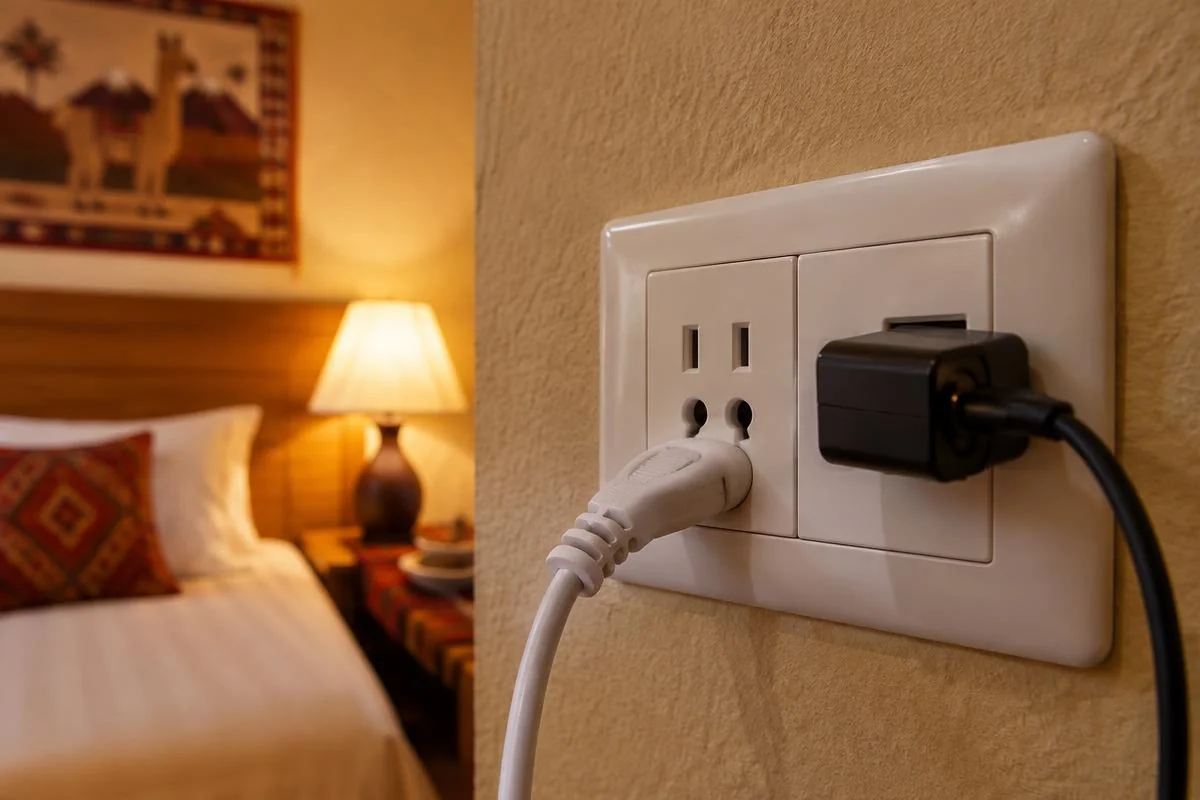
Peru uses two power plug types: Type A, with two flat parallel pins like the standard US plug, and Type C, with two round pins used across Europe and South America. Many hotels install combination outlets that accept both. Older buildings may only have round-pin Type C sockets, so pack one small adapter.
| Plug type | Pins | Common in Peru | Fits US plugs |
|---|---|---|---|
| Type A | Two flat pins | Yes, especially hotels | Yes |
| Type C | Two round pins | Yes, homes and older buildings | No, needs adapter |
| Combination A/C | Flat and round slots | Very common in hotels | Yes |
| Type B (US 3-prong) | Two flat plus ground | Rare | Needs adapter or cheater plug |
What Is the Voltage in Peru and Why Does It Matter?
The voltage in Peru is 220 volts at 60 Hz, while the US runs on 110 to 120 volts at 60 Hz. The plug may fit, but plugging a 110-volt-only appliance into a Peruvian outlet can burn it out instantly, trip the circuit or create a fire risk. Always check the device first.
The frequency matches the US at 60 Hz, so clocks and motors in dual-voltage devices run normally. Only the voltage difference needs attention.
Some upscale hotels in Lima and Cusco provide a separate 110-volt outlet, often labeled near the bathroom mirror for shavers. Do not assume it exists everywhere.
How to Check If Your Device Works on 220V
To check if your device works on 220 volts in Peru, read the small print on its charger or power brick. If it says INPUT 100-240V, the device is dual voltage and only needs a plug that fits. If it says 110V or 120V only, it needs a voltage converter or should stay home.
- Find the label on the charger, plug or power brick.
- Look for the INPUT line, not the OUTPUT line.
- Confirm a range such as 100-240V, 50/60Hz.
- Treat 110V or 120V only as single voltage.
- Check hair tools for a dual-voltage switch and set it to 220V.
- Leave single-voltage heat appliances at home.
Which Devices Need an Adapter or Converter in Peru?
In Peru, most phones, laptops, cameras, e-readers and USB chargers need no converter, because they are dual voltage, and usually no adapter if they have flat two-pin plugs. Hair dryers, curling irons, straighteners and electric shavers are often single voltage and need a converter or a dual-voltage travel version.
| Device | Usually dual voltage | What you need |
|---|---|---|
| Phone and USB charger | Yes | Nothing, or A/C adapter |
| Laptop charger | Yes | Adapter if three-prong |
| Camera battery charger | Yes | Nothing, or adapter |
| Electric toothbrush | Sometimes | Check label |
| Hair dryer | Often no | Dual-voltage dryer or skip, hotels often provide one |
| Hair straightener or curler | Often no | Dual-voltage model |
| CPAP machine | Usually yes | Check label, plan for treks |
What Adapter Should US Travelers Pack for Peru?
US travelers should pack a compact universal travel adapter that converts to Type C round pins, plus a small multi-port USB charger. That combination covers almost every Peruvian outlet and lets you charge several devices from one socket. A three-to-two-prong adapter helps with grounded laptop plugs in older hotels.
- One universal adapter with Type C pins.
- A USB charger with three or four ports.
- A short extension cord for hostel beds far from outlets.
- A power bank of 10,000 to 20,000 mAh.
- A spare charging cable for phone and camera.
The rest of your gear list is in the Machu Picchu packing list.
Can You Charge Devices on the Inca Trail and Other Treks?
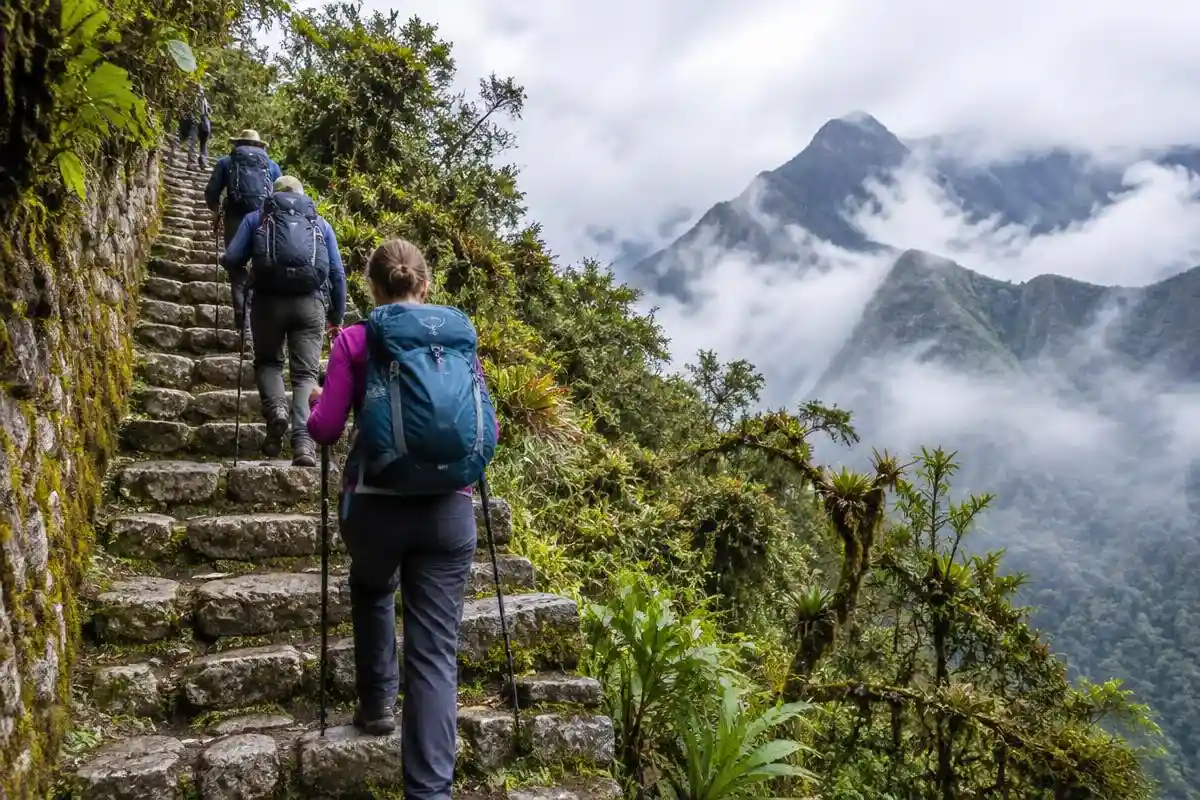
You usually cannot charge devices on the Inca Trail or most Andean treks, because campsites have no outlets. Some lodges on routes like Salkantay offer charging for a small fee, and a few treks pass villages with limited power. A large power bank and airplane mode keep a phone and camera alive for four days.
- Carry a 20,000 mAh power bank for 4-day treks.
- Keep batteries warm in your sleeping bag at night.
- Use airplane mode, since signal is rare anyway.
- Bring spare camera batteries instead of charging.
- Solar panels work only on sunny dry-season days.
Day-by-day trail conditions are covered in the Inca Trail difficulty guide and the Salkantay trek difficulty guide.
Where Can You Charge Around Machu Picchu and on Trains?
Around Machu Picchu, hotels in Aguas Calientes have normal 220-volt outlets, so you can charge fully the night before your visit. Inside the citadel there are no outlets, and most trains to Machu Picchu do not offer seat sockets. Charge everything overnight and carry a power bank for a long day.
A full Machu Picchu day with photos, maps and translation apps can drain a phone by early afternoon. A small power bank solves it.
Hotels and services in town are described in the Aguas Calientes guide, and train classes are compared in the PeruRail vs Inca Rail guide.
Are Power Outages Common in Peru?
Power outages in Peru are uncommon in Lima and central Cusco but happen more often in rural Andean villages, the Sacred Valley during storms and Amazon lodges that run generators for set hours. Keep devices charged when power is available, and carry a headlamp, since lights can fail at night.
- Amazon lodges often run power only in evenings.
- Rainy-season storms can cut rural power briefly.
- Surge protectors help in places with unstable supply.
- A headlamp is useful in older guesthouses.
- Back up photos to the cloud when you have Wi-Fi.
Frequently asked questions
Do I need a power adapter for Peru from the US?
You may not need a power adapter for Peru if your devices have flat two-pin US plugs, since many outlets accept Type A. However, round-pin Type C sockets are common in older buildings, and three-prong plugs never fit. A small universal adapter costs little and avoids being stuck without charging.
Can I use my US hair dryer in Peru?
You can use a US hair dryer in Peru only if it is dual voltage and switched to 220 volts. Most standard US dryers are 110 volts only and can burn out or overheat. Many hotels in Cusco and Lima provide a hair dryer, so leaving yours at home is often easiest.
Will my iPhone charger work in Peru?
Your iPhone charger will work in Peru, because Apple chargers are rated 100 to 240 volts. The flat two-pin plug fits Type A and combination outlets directly. If you meet a round-pin Type C socket, a simple plug adapter is enough, with no converter needed.
Can I buy a plug adapter in Peru?
You can buy plug adapters in Peru at pharmacies, electronics shops, markets and some hotel receptions in Lima and Cusco, usually for a few soles. Quality varies, and stores are harder to find in Aguas Calientes or on treks, so buying one before you leave home is more reliable.
Is Peru electricity safe for laptops?
Peru electricity is safe for most laptops, since modern laptop chargers accept 100 to 240 volts. Check the INPUT line on the brick to confirm. In areas with unstable supply, such as rural lodges, unplug during storms or use a small surge protector to guard against voltage spikes.
What plug do I need for Cusco?
In Cusco, most hotels have combination outlets that take US flat pins and European round pins, at 220 volts. Older guesthouses and homestays may only have round-pin Type C sockets. Pack a Type C adapter and confirm your devices are dual voltage before plugging in.
Do Peruvian outlets have a ground pin?
Most Peruvian outlets do not have a ground pin, since Type A and Type C sockets are two-pin designs. Grounded US three-prong plugs, common on laptops and some appliances, need an adapter. Newer buildings sometimes add grounded sockets, but you cannot count on them in hotels or hostels.
Can I bring a power bank on flights to Peru?
You can bring a power bank on flights to Peru in carry-on luggage only, not in checked bags. Airlines generally allow batteries up to 100 watt-hours without approval, which covers most power banks under about 27,000 mAh. Check your airline's rules for larger batteries.
Planning a trek or Machu Picchu trip?
Send us your dates and we will share a plan with hotels, trains and charging stops in mind. Prefer to read first? Get the free Machu Picchu trip guide.
Sources checked October 4, 2026
Recommended tours
Inca Trail · 4 days
Classic Inca Trail to Machu Picchu, 4 Days
The world-famous 43 km trek on original Inca stone paths, ending at the Sun Gate.
from $827
View tour →
Treks · 5 days
Salkantay Trek to Machu Picchu, 5 Days
The best alternative to the Inca Trail: Humantay Lake, a 4,630 m pass and cloud forest.
from $490
View tour →
Machu Picchu · 1 day
Machu Picchu Day Trip from Cusco
Train, bus, entry ticket and guided tour of Machu Picchu in one easy day from Cusco.
from $379
View tour →Keep planning
- Machu Picchu Tickets 2026: Prices, Ticket Types and How to Buy
- Best Time to Visit Machu Picchu: Best Months, Seasons and Time of Day
- How to Get to Machu Picchu: Every Route From Cusco Compared
- Machu Picchu Hotels: Best Places to Stay Near the Citadel by Area and Budget
- Machu Picchu Map: Where It Is in Peru and How the Ruins Are Laid Out
- Machu Picchu Cost Breakdown: How Much It Costs to Go in 2026
- Machu Picchu Rules and Regulations: The Complete 2026 Visitor Code
- Machu Picchu in December: Is a Rainy-Season Holiday Visit Worth It?