
Sacsayhuamán: The Megalithic Inca Fortress Above Cusco Explained
By the Goo Machu Picchu team · Checked against official sources (editorial policy) · Updated October 2026 · 6 min read
Sacsayhuamán is an Inca ceremonial and military complex on a hill just north of Cusco, Peru, at about 12,140 feet (3,700 m). It is famous for three tiers of zigzag walls built from enormous fitted limestone blocks, some estimated at well over 100 tons, and sits about a 20 to 30 minute uphill walk from the Plaza de Armas.
- Also spelled
- Saqsaywaman, Saksaywaman
- Location
- Northern edge of Cusco, Peru
- Elevation
- About 12,140 ft (3,700 m)
- Built
- Mainly 15th to early 16th century
- Entry
- Cusco Tourist Ticket (Boleto Turístico)
- Time needed
- About 1.5 to 2 hours
What Is Sacsayhuamán and What Does the Name Mean?
Sacsayhuamán is a walled Inca complex overlooking Cusco, the former capital of the Inca Empire, and part of the City of Cuzco UNESCO World Heritage Site. The Quechua name is usually translated as satisfied falcon or royal falcon, from saqsay, to be full, and waman, falcon or hawk.
Most English speakers pronounce Sacsayhuamán roughly as sak-sigh-wah-MAHN. Guides often joke that it sounds like sexy woman, which helps visitors remember it.
A popular story says Cusco was laid out in the shape of a puma, with Sacsayhuamán as its head and the zigzag walls as its teeth. Historians treat this as a tradition rather than proven fact.
For the full picture, start with our Cusco, Peru guide.
Who Built Sacsayhuamán, and When?
Spanish chroniclers recorded that Sacsayhuamán was built mainly under the Inca ruler Pachacuti in the 15th century and expanded by his successors Túpac Inca Yupanqui and Huayna Capac. Archaeologists have also found earlier Killke culture remains on the hill, from around 900 to 1200 CE, so the site was used before the Incas.
Chroniclers described thousands of laborers working in rotating shifts under the mit'a labor tax. Exact worker numbers and the time construction took are uncertain, and figures vary widely between sources. The broader Inca story is in our Machu Picchu history guide.
How Were the Giant Walls of Sacsayhuamán Built?
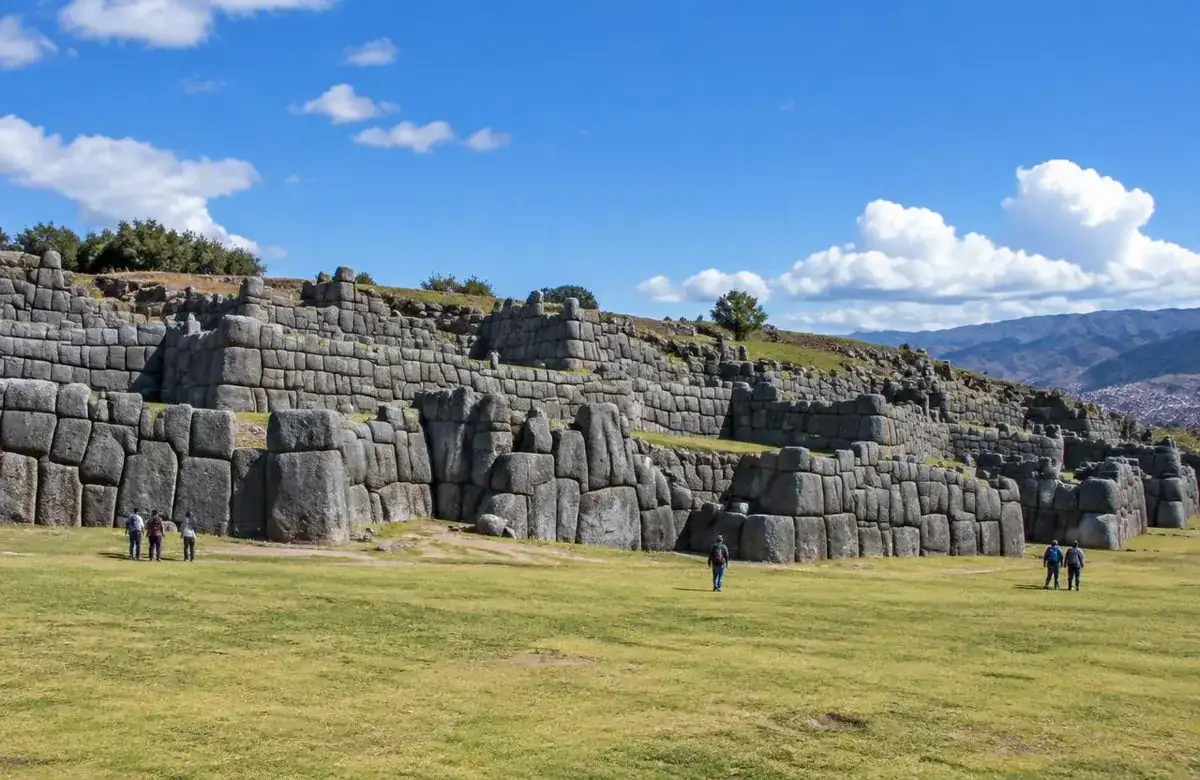
The giant walls of Sacsayhuamán were built from huge limestone and andesite blocks cut and shaped with harder hammerstones, then moved with ropes, ramps, wooden levers and large teams of workers. Each block was ground to fit its neighbors so tightly that no mortar was needed. The largest stone is estimated at roughly 125 to 200 tons.
The three terraced walls run about 1,300 feet (400 m) in a zigzag pattern, which may have helped defense and withstand earthquakes. Weight estimates for the biggest blocks differ by source, so treat any single figure with caution.
Andesite for some structures was brought from quarries as far as about 20 miles away, while the main limestone came from nearby. Experiments have shown teams of about 100 people can drag multi-ton stones on prepared surfaces.
What Happened at Sacsayhuamán During the Spanish Conquest?
During the Siege of Cusco in 1536, the Inca ruler Manco Inca used Sacsayhuamán as his base against Spanish forces in the city. After heavy fighting, the Spanish and their Indigenous allies captured the complex, and Juan Pizarro was killed in the attack. The defeat helped end the siege and pushed Manco Inca toward Vilcabamba.
After the conquest, the Spanish used Sacsayhuamán as a quarry. Smaller stones were carried down to build colonial churches and houses in Cusco, which is why mostly the largest blocks remain. Manco Inca's later stand is covered in our Ollantaytambo town and ruins guide.
What Can You See at Sacsayhuamán Today?
At Sacsayhuamán today you can see the three tiers of zigzag walls, the wide esplanade used for Inti Raymi, the foundations of three towers once called Muyuq Marka, Sallaq Marka and Paucar Marka, the polished Rodadero rock and so-called Inca Throne, and short rock passages known as the Chinkana. Views over Cusco are excellent.
- Zigzag walls: the giant fitted stones most visitors come for.
- Esplanade: the large grassy plaza facing the walls.
- Muyuq Marka: circular tower foundation on the hilltop.
- Rodadero: smooth rock slope on Suchuna hill with carved seats known as the Inca Throne.
- Chinkana: natural rock channels used as short tunnels.
- Cusco viewpoint: wide views over the city's red rooftops.
How Much Is the Sacsayhuamán Entrance Ticket?
Sacsayhuamán does not sell a separate ticket for foreign visitors. Entry is through the Cusco Tourist Ticket, the Boleto Turístico, reported at about S/130 for the full 10-day pass covering 16 sites, or about S/70 for the partial Circuit I pass covering Sacsayhuamán and nearby ruins. Check current prices at the official ticket office.
| Pass | Reported price | Includes |
|---|---|---|
| Full Boleto Turístico | About S/130 | Sacsayhuamán plus 15 sites, 10 days |
| Partial Circuit I | About S/70 | Sacsayhuamán, Qenqo, Puka Pukara, Tambomachay |
| Partial Circuit III | About S/70 | Sacred Valley sites incl. Ollantaytambo |
| Student full pass | About S/70 | Valid student card required |
Prices are reported by tour operators and can change. The pass is sold at the Cusco tourist office (COSITUC) and at some site entrances, usually in cash.
How Do You Get to Sacsayhuamán From Cusco?
You can walk to Sacsayhuamán from Cusco's Plaza de Armas in about 20 to 30 minutes up steep stone streets through the San Cristóbal area, take a taxi in about 10 minutes, or visit on a half-day Cusco city tour that also stops at Qenqo, Puka Pukara and Tambomachay. Walking is steep at this altitude.
- Spend at least one day in Cusco adjusting to the altitude.
- Buy your Boleto Turístico before you go.
- Walk up from the Plaza de Armas via Calle Suecia or take a taxi.
- Show your pass at the entrance.
- Allow about 1.5 to 2 hours on site.
- Walk on to Cristo Blanco for sunset views, or return downhill.
At about 12,140 feet, the site is higher than central Cusco, so go slowly; see our Cusco altitude guide.
More sights for your city days are in our list of things to do in Cusco, and our Cusco map guide shows how they fit together.
When Is the Best Time to Visit Sacsayhuamán?
The best time to visit Sacsayhuamán is early morning, soon after opening at around 7 am, or late afternoon before closing at around 5:30 pm, when light is soft and tour groups are fewer. The dry season from May to September has clearer skies, while June 24 brings Inti Raymi crowds and closures.
Inti Raymi, the Inca festival of the sun, is restaged on the esplanade every June 24. Grandstand seats are sold separately and normal visits are restricted that day. Seasonal patterns are explained in our best time to visit Machu Picchu guide.
If you are also weighing this, see our Qorikancha guide.
Prefer to have it all arranged? Alongside this Sacsayhuamán Peru guide, our Machu Picchu vacation packages covers transport, tickets and a licensed guide.
Sacsayhuamán sits uphill from the center, so check our Cusco map of neighborhoods and sites and adjust first with Cusco altitude tips.
Frequently asked questions
Is Sacsayhuamán worth visiting?
Sacsayhuamán is worth visiting for the most impressive Inca stonework near Cusco, with fitted megaliths larger than any at Machu Picchu. It is close to the city, takes about two hours, and pairs easily with Qenqo and Cristo Blanco. Many travelers visit it as altitude practice before Machu Picchu.
Was Sacsayhuamán a fortress or a temple?
Sacsayhuamán is often called a fortress because of its walls and its role in the 1536 siege, but many researchers see it mainly as a ceremonial and religious complex with storehouses and towers. It likely served several purposes, and the Incas did not separate military and sacred spaces the way modern visitors do.
Do you need a guide at Sacsayhuamán?
You do not need a guide to enter Sacsayhuamán, but a licensed guide explains the walls, towers and history that the few signs barely cover. Guides wait near the entrance, or the site is included on most half-day Cusco city tours. Agree on price before starting.
Is Sacsayhuamán older than Machu Picchu?
Sacsayhuamán has roots older than Machu Picchu, since Killke culture remains on the hill date to around 900 to 1200 CE. The main Inca walls were built around the same era as Machu Picchu, under Pachacuti and his successors in the 15th century. See [what Machu Picchu is](/guides/what-is-machu-picchu) for comparison.
Can you touch the stones at Sacsayhuamán?
Visitors can usually walk beside the walls at Sacsayhuamán, and lightly touching the stones is commonly tolerated, but climbing on walls or towers is forbidden. Rules and roped-off areas change to protect the site, especially after rain, so follow guards' instructions and posted signs during your visit.
Want Sacsayhuamán in your Cusco days?
Tell us your dates and we will plan Sacsayhuamán on an easy acclimatization day before Machu Picchu. Prefer to read first? Get the free Machu Picchu trip guide.
Sources checked October 3, 2026
Recommended tours
Packages · 7 days
Machu Picchu Vacation Packages, 3, 5 and 7 Days
3, 5 or 7 days from Cusco with hotels, trains, Machu Picchu tickets and guides arranged. From $479.
from $1290
View tour →
Day Tours · 1 day
Sacred Valley Full Day Tour
Chinchero, Moray, Maras salt mines, Ollantaytambo and Pisac in one full day from Cusco, with buffet lunch.
from $49
View tour →Keep planning
- Aguas Calientes Hotels: Where to Stay in Machu Picchu Town and How to Choose
- Aguas Calientes Hot Springs: A Practical Guide to the Thermal Baths Below Machu Picchu
- Ollantaytambo: The Inca Fortress Town of the Sacred Valley Explained
- Qorikancha: The Golden Inca Temple of the Sun in Cusco
- Maras Salt Mines: How the Salineras de Maras Work and How to Visit
- Moray Ruins: The Inca Circular Terraces of the Sacred Valley Explained
- Pisac Ruins: The Inca Citadel and Market Town of the Sacred Valley
- Things to Do in Cusco: The Best Sights, Day Trips and Local Food