
Huayna Picchu: Hike Guide to the Peak Behind Machu Picchu
By the Goo Machu Picchu team · Checked against official sources (editorial policy) · Updated October 2026 · 14 min read
Huayna Picchu is the steep green peak that rises behind the Machu Picchu citadel in every classic photo. The summit stands at 2,693 m (8,835 ft), and the climb from the trail gate takes about 2 to 3 hours round trip on narrow Inca stone stairs. Entry requires a Route 3A ticket, limited to a few hundred hikers a day.
This guide explains Huayna Picchu in the order hikers usually wonder about it: what the mountain is, how high and how hard it is, how safe it feels, how the ticket works, when to go, and whether Machu Picchu Mountain is the better choice.
- Summit height
- 2,693 m (8,835 ft)
- Climb from the gate
- About 300 m (1,000 ft) of stairs
- Time on the trail
- 2 to 3 hours round trip
- Ticket
- Route 3A, S/211 for foreign adults
- Daily hikers
- About 350 to 400, two entry groups
- Best months
- May to September (dry season)
What Is Huayna Picchu?
Huayna Picchu: a 2,693 m mountain on the north side of the Machu Picchu citadel in Peru, crowned with Inca terraces, stairways and small temples. Huayna Picchu, also spelled Wayna Picchu, is part of the Historic Sanctuary of Machu Picchu, a UNESCO World Heritage Site since 1983, and can be climbed with a special ticket.
The Incas did not leave the peak wild. They carved a staircase into the rock, built farming terraces near the summit and placed shrines on the slopes, which is why the hike feels like walking through part of the ancient city rather than up an ordinary trail.
Huayna Picchu is part of Circuit 3, and the other nine routes are compared in our Machu Picchu circuits and routes guide.
The taller, less exposed alternative is covered in our Machu Picchu Mountain hike guide.
What Does Huayna Picchu Mean?
Huayna Picchu means "young peak" in Quechua, the language of the Incas, from wayna (young) and pikchu (peak). The name pairs with Machu Picchu, "old peak", the taller mountain on the opposite side of the ruins. Both spellings, Huayna and Wayna, are correct and appear on signs and tickets.
Where Is Huayna Picchu Located?
Huayna Picchu sits directly north of the Machu Picchu ruins, inside a sharp bend of the Urubamba River in the Cusco region of Peru. The nearest town is Aguas Calientes, about 25 minutes below by bus. The trail gate is at the far end of the citadel, past the Sacred Rock.
Reaching the citadel itself is covered in how to get to Machu Picchu from Cusco.
How High Is Huayna Picchu? Elevation and Altitude Gain
Huayna Picchu reaches 2,693 m (8,835 ft) above sea level, about 260 to 300 m higher than the Machu Picchu citadel at 2,430 m (7,970 ft). From the trail gate, hikers gain roughly 300 m (1,000 ft) of elevation. Some websites quote 2,700 or 2,720 m, but 2,693 m is the most cited figure.
| Place | Elevation | In feet |
|---|---|---|
| Aguas Calientes town | About 2,040 m | About 6,690 ft |
| Machu Picchu citadel | 2,430 m | 7,970 ft |
| Huayna Picchu summit | 2,693 m | 8,835 ft |
| Machu Picchu Mountain summit | 3,082 m | 10,111 ft |
| Cusco city, for comparison | 3,400 m | 11,150 ft |
Hikers coming from Cusco are already used to higher ground, so altitude sickness on Huayna Picchu is uncommon. The effort comes from steepness, not thin air. Altitude tips for the whole trip are in the Machu Picchu altitude guide.
What Is the Huayna Picchu Hike Like? Trail, Steps and Time
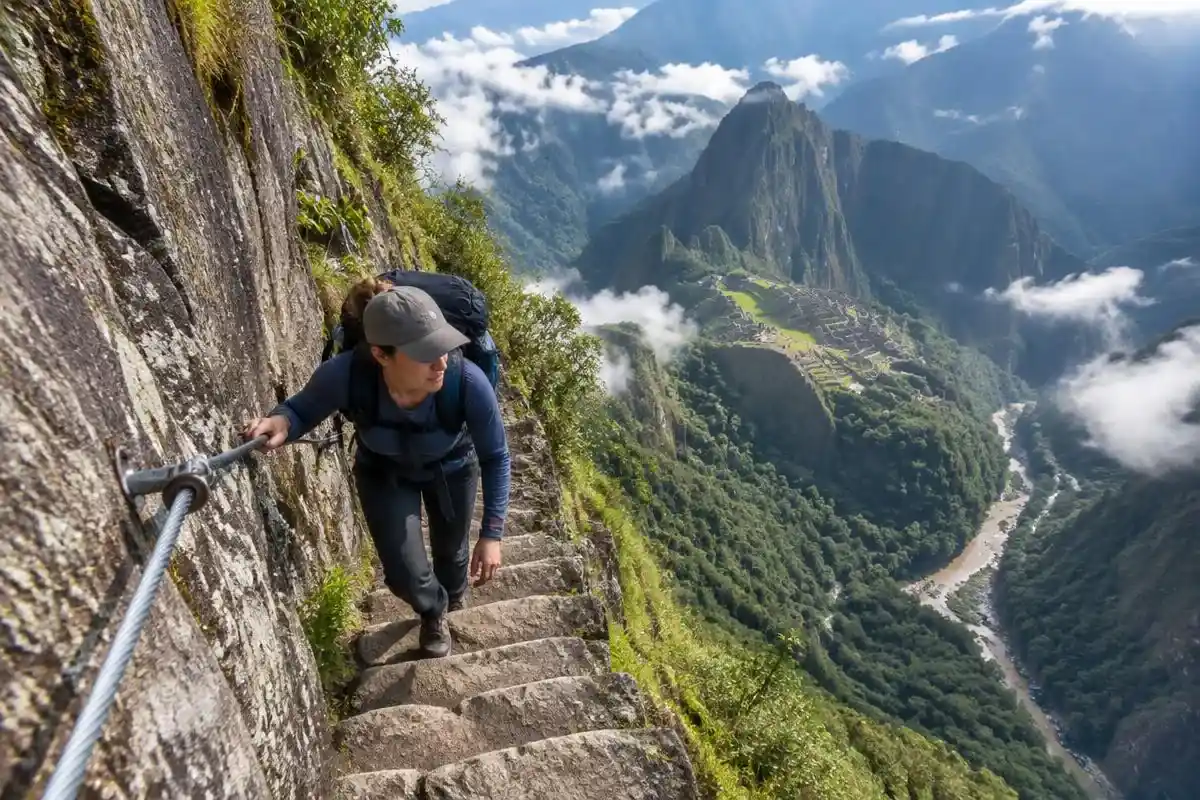
The Huayna Picchu hike is a short, steep climb on original Inca stone stairs that zigzag up the mountain face. Hikers sign in at a control hut, climb through cloud forest to a saddle, then tackle steeper stairs, a narrow cave passage and summit terraces. Most people reach the top in 45 to 75 minutes.
Segment by Segment: From the Gate to the Summit
The Huayna Picchu trail breaks into five clear parts: a gentle start, a forest switchback climb, a saddle with terraces, the steep upper stairs, and the summit rocks. Knowing the order helps hikers pace themselves, because the hardest steps come in the last 20 minutes, when legs are already tired.
| Segment | What it feels like | Typical time up |
|---|---|---|
| Control hut to forest | Easy path, sign in with passport | 5 to 10 min |
| Forest switchbacks | Steady stone steps, shaded | 15 to 20 min |
| Saddle and lower terraces | Short rest point, first views | 5 to 10 min |
| Upper stairs and cave passage | Steep, narrow, cables, a low tunnel | 15 to 25 min |
| Summit rocks and stairs of death | Exposed steps, best views | 10 to 15 min |
How Many Steps Are on Huayna Picchu?
Huayna Picchu has hundreds of uneven stone steps, and counts quoted online range from several hundred to more than 1,600 depending on where they start counting. No official count exists. What matters more is height: many steps are knee-high and narrow, so the climb feels like a long, steep staircase rather than a trail.
How Long Does It Take to Climb Huayna Picchu?
Climbing Huayna Picchu takes most hikers 45 to 75 minutes up and 40 to 60 minutes down, so 2 to 3 hours on the trail in total. Add about 1 hour for the Circuit 3 walk through the citadel. Park rules give each group a set window, so slow hikers should start right at their entry time.
The Summit and the View Back Over Machu Picchu
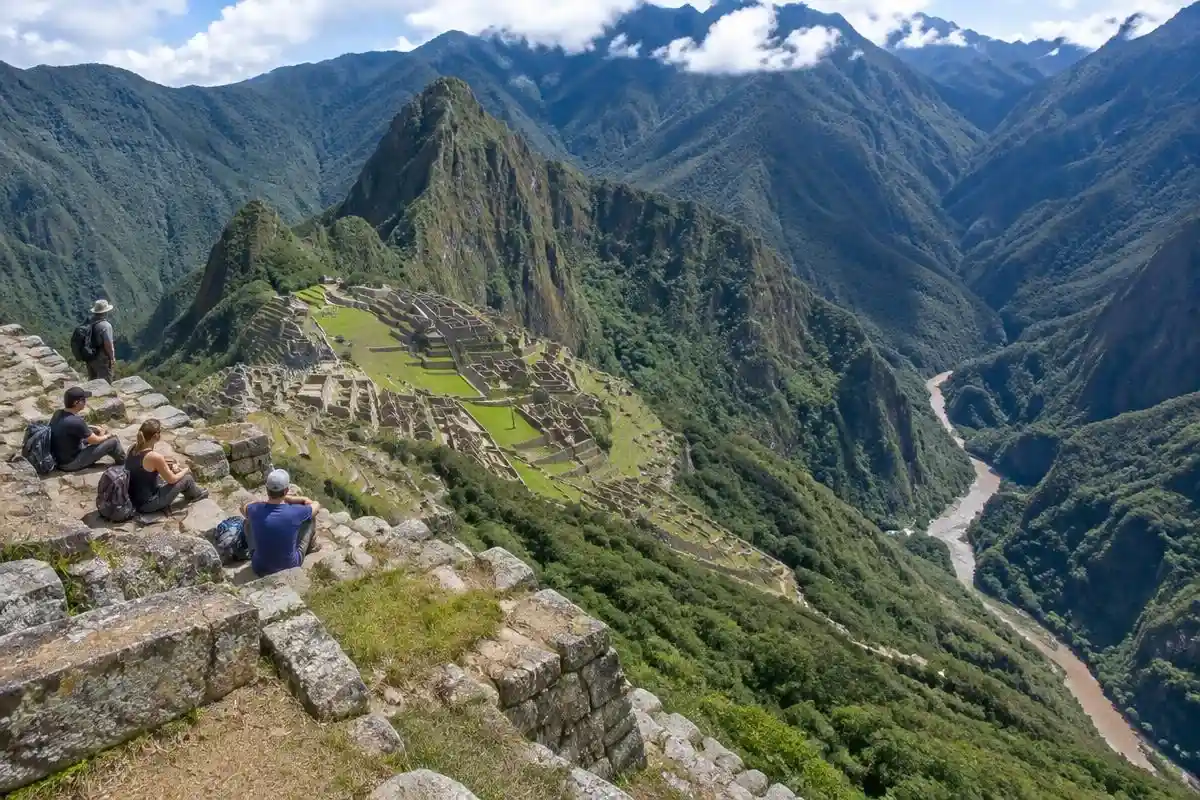
The Huayna Picchu summit is a cluster of granite boulders and small Inca terraces with a bird's-eye view straight down onto the Machu Picchu citadel. From the top, the zigzag Hiram Bingham road, the Urubamba River and the Sun Gate are all visible. Mornings often start in cloud that lifts by mid-morning.
How Hard Is Huayna Picchu? Difficulty and Fitness Needed
Huayna Picchu is a moderate to strenuous hike: short, but very steep and exposed in places. Anyone who can climb 60 to 80 flights of stairs with breaks can finish it. No technical climbing skills are needed. The real difficulty is knee strain on the way down and comfort with heights, not fitness alone.
- Fitness: regular walking or stair workouts in the weeks before the trip are enough for most travelers.
- Knees: the descent is harder than the climb for many hikers, so trekking poles with rubber tips help.
- Pace: stopping often is normal, and other hikers step aside on wider ledges.
- Heat and humidity: the forest section is warm, so carrying water matters more than at Cusco.
Can Beginners or Older Hikers Climb It?
Beginners and active older hikers do climb Huayna Picchu, as long as they take it slowly and feel steady on stairs. The trail suits people who walk regularly, not those with heart conditions, bad balance or recent knee injuries. Hikers unsure about it often choose Route 3D, Huchuy Picchu, instead.
Huayna Picchu vs Angels Landing: A US Comparison
For American hikers, Huayna Picchu feels shorter and less exposed than Angels Landing in Zion National Park, but steeper underfoot. Angels Landing climbs about 450 m on a chain-assisted fin, while Huayna Picchu gains about 300 m on stone stairs with cables. Anyone comfortable on Angels Landing will manage Huayna Picchu easily.
| Feature | Huayna Picchu | Angels Landing |
|---|---|---|
| Elevation gain | About 300 m (1,000 ft) | About 450 m (1,500 ft) |
| Round trip | 2 to 3 hours | 4 to 5 hours |
| Surface | Inca stone stairs | Paved switchbacks, then rock fin |
| Exposure | Short exposed sections | Long exposed ridge with chains |
| Permit | Route 3A ticket | Lottery permit |
Is Huayna Picchu Dangerous? The Stairs of Death and Safety Facts
Huayna Picchu is safe for careful hikers in dry weather, despite its nickname, the stairs of death. The steep summit steps have steel cables, and rangers control numbers. Accidents are rare and usually involve slipping on wet stone, leaving the trail or taking risky photos. Rain is the biggest danger.
The stairs of death are a short flight of very steep, narrow steps near the top, with a drop on one side. Most hikers go down them facing the mountain, holding the cable, which removes most of the fear.
Have People Died on Huayna Picchu?
A small number of deaths have been reported on Huayna Picchu over the decades, mostly from falls after leaving the marked trail or climbing on rocks for photos. Peru publishes no official yearly death count, so numbers circulating online are not reliable. Against hundreds of hikers every day, serious accidents remain very rare.
Climbing With a Fear of Heights
Hikers with a mild fear of heights usually finish Huayna Picchu by keeping their eyes on the steps and using the cables. Strong vertigo is different: the upper stairs and summit ledges have open drops, and turning back halfway is common. Machu Picchu Mountain is the wider, less exposed alternative.
- Climb in a group and let faster hikers pass.
- Face the mountain on the steepest steps going down.
- Skip the summit boulders; the terraces just below have nearly the same view.
- Turn back at the saddle if your legs feel shaky; the view there is already good.
Safety Tips for the Trail
The safest way to hike Huayna Picchu is to wear shoes with real grip, keep both hands free, stay on marked steps and avoid edges for photos. Start at your entry time so you are not rushing on the descent. If heavy rain starts, rangers may close the trail, and that decision protects hikers.
Huayna Picchu Tickets: Route 3A Price and What It Includes
Huayna Picchu tickets are sold only as Route 3A, Circuit 3, a combined pass for the mountain hike plus the lower Machu Picchu citadel. A foreign adult pays S/211, about $58, from May 1, 2026. Only about 350 to 400 Route 3A tickets exist each day, so they sell out before every other Machu Picchu ticket.
Prices, student rates and the full list of routes are explained in the main Machu Picchu tickets guide.
What the Route 3A Ticket Lets You See in the Citadel
The Route 3A ticket covers the Huayna Picchu climb and the lower Circuit 3 path through the citadel, including the Royal Residence and the Temple of the Condor. Route 3A does not reach the upper viewpoint for the classic postcard photo. Hikers who want that photo buy a second ticket, usually Route 2A or 1B.
How to Book Huayna Picchu Tickets
Huayna Picchu tickets are booked on the official website, tuboleto.cultura.pe, by choosing Llaqta de Machu Picchu, then Route 3A, a date and one of two entry groups. Each hiker's passport number must be entered exactly. Licensed agencies can also book Route 3A, adding a service fee to the official price.
- Open tuboleto.cultura.pe and pick Llaqta de Machu Picchu.
- Select Circuit 3 and Route 3A, Huayna Picchu.
- Choose the date, then the first or second entry group.
- Enter passport details for every hiker.
- Pay by Visa or Mastercard and save the PDF ticket.
Entry Times and Daily Limits
Huayna Picchu has two entry groups each morning, usually around 7 to 8 am and a later mid-morning group, with roughly half the daily hikers in each. The exact hours are printed on the ticket and can change by season. Hikers sign in at the control hut and must return before the trail closes.
What If Huayna Picchu Tickets Are Sold Out?
When Huayna Picchu tickets are sold out, the closest alternatives are Machu Picchu Mountain (Route 1A), Huchuy Picchu (Route 3D) in high season, or the Sun Gate hike (Route 1C). Another option is a different date. Licensed operators sometimes still hold Route 3A spaces reserved inside their tours.
Our Machu Picchu packages with mountain tickets can include Route 3A when space is available on your dates.
Inca Trail Hikers and Huayna Picchu
Inca Trail hikers can add Huayna Picchu, but the Inca Trail permit does not include it. A separate Route 3A ticket is needed, usually for the day after arrival, because the trek reaches Machu Picchu after the Huayna Picchu groups have started. Booking both together is the safest plan.
How permits work is covered in the Inca Trail permits guide.
When Is the Best Time to Hike Huayna Picchu?
The best time to hike Huayna Picchu is the dry season, from May to September, when the stone stairs are dry and summit views are clearest. April and October are good shoulder months. From November to March, rain makes the steps slippery, and the summit is often wrapped in cloud until late morning.
Dry Season vs Rainy Season
In the dry season, Huayna Picchu has firm footing, cool mornings and the highest demand for tickets. The rainy season brings fewer hikers and greener scenery but wet, slick stairs and frequent fog. February is the wettest month, and trail closures during storms are possible.
Month-by-month rain and temperatures are in Machu Picchu weather by month, and crowd levels are in the best time to visit Machu Picchu.
Best Time Slot of the Day
The first Huayna Picchu group starts cooler and has the trail less crowded, but the summit is often in morning cloud. The second group climbs warmer and busier, yet more often reaches the top as the cloud lifts. Photographers usually prefer the second group, while hikers who dislike heat choose the first.
Early slots are much easier if you sleep near the ruins, which is why many hikers spend the night before in Aguas Calientes, the town below Machu Picchu.
Huayna Picchu Rules: Age Limit, Poles and What You Cannot Bring
Huayna Picchu follows the Machu Picchu rules plus a few trail rules. Hikers sign in and out with their passport at the control hut, must keep to the marked path and cannot bring large backpacks, food, drones or poles with metal tips. Children are generally expected to be at least 12 years old.
Huayna Picchu Age Limits and Who Should Skip It
Huayna Picchu is not recommended for children under about 12, and many operators apply 12 as the minimum age. Older children who are steady on stairs and calm with heights usually enjoy the climb. Families with younger kids often choose Huchuy Picchu or the Circuit 2 citadel visit instead.
What to Wear and Bring for the Huayna Picchu Hike
For Huayna Picchu, wear hiking shoes or trail runners with deep grip, light layers and a rain jacket, and carry water, sunscreen and your passport. A small daypack keeps both hands free on the cables. Large backpacks are not allowed inside Machu Picchu and can be left at the entrance lockers.
- Grippy hiking shoes, not smooth sneakers or sandals
- About 1 liter of water in a reusable bottle
- Rain jacket or poncho, even in the dry season
- Sunscreen, hat and insect repellent for the forest section
- Original passport and printed or digital Route 3A ticket
- Trekking poles with rubber tips if your knees need support
Huayna Picchu or Machu Picchu Mountain: Which Should You Choose?
Choose Huayna Picchu for a shorter, steeper climb with a close bird's-eye view of the citadel. Choose Machu Picchu Mountain for a longer, higher hike on wider steps with less exposure and a 360-degree panorama. Huayna Picchu sells out sooner, while Machu Picchu Mountain suits hikers who dislike heights.
| Feature | Huayna Picchu (3A) | Machu Picchu Mountain (1A) |
|---|---|---|
| Summit height | 2,693 m (8,835 ft) | 3,082 m (10,111 ft) |
| Climb from the gate | About 300 m | About 600 m |
| Round trip | 2 to 3 hours | 3 to 4 hours |
| Exposure | Narrow, steep, cables | Wider steps, fewer drops |
| View | Close, straight down on the ruins | Far, 360-degree panorama |
| Classic photo in citadel | No (Circuit 3) | Yes (Circuit 1) |
| Sells out | First | Second |
Huchuy Picchu: The Short Alternative
Huchuy Picchu, "little peak", is a small hill beside Huayna Picchu sold as Route 3D in high season at the regular ticket price. The climb takes only 20 to 30 minutes and has no exposed ledges. Huchuy Picchu suits families, nervous hikers and anyone who wants a raised view without the effort.
Huayna Picchu Route 3C: Hiking Down to the Temple of the Moon
Route 3C is the longer Huayna Picchu trail that skips the summit and drops down the mountain's hidden north face to the Temple of the Moon, a cave shrine inside the Great Cavern. The standard Route 3A summit ticket does not include it. Hikers choose Route 3C for quiet trails and more effort rather than the summit view.
The trail descends steeply and climbs back up, taking about 4 to 5 hours, so it suits fit hikers comfortable with long stair sections. The shrine itself is covered in our Temple of the Moon guide. Ticket details for this circuit are listed under Route 3C in our Machu Picchu tickets guide.
History of Huayna Picchu: Why the Incas Built on the Peak
The Incas built on Huayna Picchu in the 15th century, during the same period as the Machu Picchu citadel, associated with the emperor Pachacuti. Terraces near the summit grew crops, and the small buildings likely housed priests or guards. The peak may also have worked as a lookout over the Urubamba valley.
The explorer Hiram Bingham brought Machu Picchu to world attention in 1911, and Huayna Picchu appeared behind the ruins in his photographs, which made its shape famous. Origins of the citadel are covered in the Machu Picchu travel guides.
Is Huayna Picchu Worth It?
Huayna Picchu is worth it for hikers who are comfortable on steep stairs and want the most dramatic view of Machu Picchu from above. It is less worth it for people with strong vertigo, bad knees or a tight train schedule, because the Route 3A ticket also skips the classic postcard viewpoint.
- Worth it: first visit with time for two tickets, good fitness, dry-season date.
- Worth it: hikers who want an Inca trail experience without a multi-day trek.
- Skip it: strong fear of heights, knee problems, or arriving on a late train.
- Skip it: a single-ticket visit where the classic photo matters most.
Frequently asked questions
Is Huayna Picchu the same as Wayna Picchu?
Yes. Huayna Picchu and Wayna Picchu are two spellings of the same mountain. Wayna is closer to the original Quechua, and it appears on many official signs and on the ticket website, while Huayna is the older Spanish spelling that most English guides and maps still use.
Do I need a guide to climb Huayna Picchu?
A guide is needed to enter Machu Picchu in 2026, but guides usually wait while hikers climb Huayna Picchu itself. Rangers at the control hut check passports and times. Most visitors walk the mountain trail on their own, then rejoin their guide for the citadel section.
Can you climb Huayna Picchu in the rain?
Light rain does not usually stop the Huayna Picchu climb, but the stone stairs become slippery and the views disappear in cloud. Rangers close the trail in heavy rain or storms. Hikers with a rainy-season date should bring grippy shoes, a poncho and extra time.
Can I do Huayna Picchu and Machu Picchu Mountain on the same day?
Doing both mountains on one day is possible with two separate tickets, but very tiring, since together they add about 900 m of steep stairs. Most travelers who want both peaks book them on two different days and stay a night in Aguas Calientes between the visits.
Is there a bathroom on Huayna Picchu?
There are no bathrooms on the Huayna Picchu trail or inside the citadel. The only restrooms are outside the main entrance gate. Hikers should use them before entering, because leaving the site to use them may end the visit for that ticket.
Can I climb Huayna Picchu without a ticket?
No. Rangers check every hiker's Route 3A ticket and passport at the Huayna Picchu control hut, and the trail is closed to anyone with another route. A standard Machu Picchu ticket cannot be upgraded inside the site, so the mountain ticket must be bought in advance.
How many hours can I stay in Machu Picchu with a Huayna Picchu ticket?
A Route 3A ticket allows time for the mountain climb plus the Circuit 3 citadel walk, usually 4 to 5 hours in total and up to around 6 hours by some operators' accounts. Rangers close the trail behind each group, so the visit cannot be extended into the afternoon.
Is Huayna Picchu harder than the Inca Trail?
Huayna Picchu is much shorter than the Inca Trail but steeper in a single push. The 4-day Inca Trail covers about 42 km with a 4,215 m pass, so it demands far more endurance. Hikers who finish the Inca Trail rarely find Huayna Picchu difficult.
Is it safe to take photos on the Huayna Picchu summit?
Taking photos on the Huayna Picchu summit is safe from the terraces and wider rocks. Most accidents happen when visitors climb onto exposed boulders or stand near edges for a picture. Staying low, keeping a hand on the rock and letting others pass keeps the summit safe for everyone.
Can I hike Huayna Picchu on a day trip from Cusco?
Hiking Huayna Picchu on a day trip from Cusco is difficult, because the earliest trains reach Aguas Calientes after the first Huayna Picchu group has started. A night in Aguas Calientes before the climb makes the timing far easier and leaves time for the second citadel ticket.
Planning to climb Huayna Picchu?
Send us your dates with the form and we will check Route 3A space and suggest the best entry group for your train, or a Machu Picchu day trip if the mountain is full. You can also ask for our free Machu Picchu planning guide.
Sources checked October 3, 2026
Recommended tours
Packages · 7 days
Machu Picchu Vacation Packages, 3, 5 and 7 Days
3, 5 or 7 days from Cusco with hotels, trains, Machu Picchu tickets and guides arranged. From $479.
from $1290
View tour →
Machu Picchu · 1 day
Machu Picchu Day Trip from Cusco
Train, bus, entry ticket and guided tour of Machu Picchu in one easy day from Cusco.
from $379
View tour →Keep planning
- Machu Picchu Circuits Explained: Circuit 1, 2 and 3 and All 10 Routes
- Machu Picchu Mountain: Hike Guide to the Tallest Peak Above the Citadel
- Temple of the Sun at Machu Picchu: The Inca Solstice Tower Explained
- Sun Gate Machu Picchu: How to Hike to Inti Punku and What You Will See
- Intihuatana Stone at Machu Picchu: Meaning, Purpose and How to See It
- Inca Bridge Machu Picchu: The Cliffside Trail and Secret Log Crossing
- Temple of the Moon at Machu Picchu: The Hidden Cave Shrine on Huayna Picchu
- Machu Picchu Tickets 2026: Prices, Ticket Types and How to Buy