
Maras Salt Mines: How the Salineras de Maras Work and How to Visit
By the Goo Machu Picchu team · Checked against official sources (editorial policy) · Updated October 2026 · 5 min read
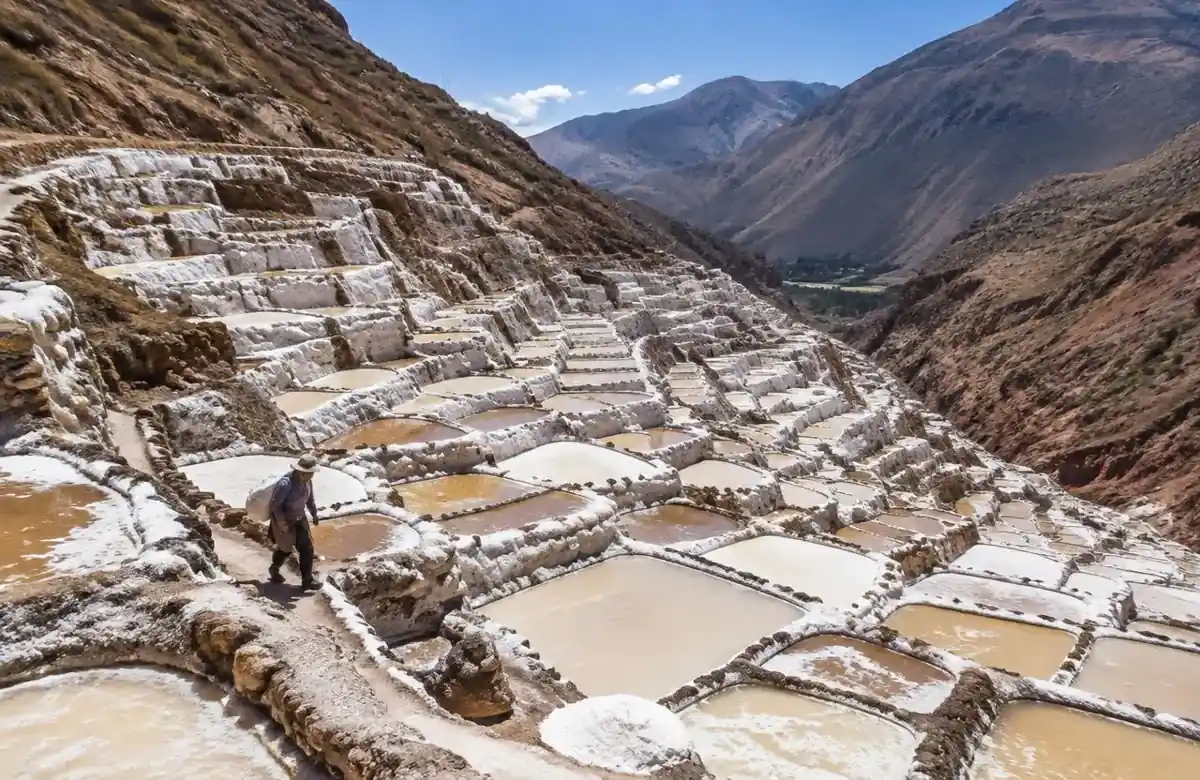
The Maras salt mines, or Salineras de Maras, are about 4,500 terraced salt pools on a mountainside in Peru's Sacred Valley, near the village of Maras at roughly 10,500 feet (3,200 m). Salty spring water flows into the pools, evaporates in the sun, and leaves salt that local families still harvest by hand today.
- Spanish name
- Salineras de Maras
- Location
- Urubamba Province, Cusco Region
- Elevation
- About 10,500 ft (3,200 m)
- Salt pools
- About 4,500
- Families harvesting
- About 400
- From Cusco
- About 1.5 hours by road
What Are the Maras Salt Mines?
The Maras salt mines are one of the largest pre-Hispanic salt production sites in the Cusco region: a slope of small evaporation pools fed by a natural salty spring. They are not underground mines but open-air salt pans. Peru nominated the site to UNESCO's World Heritage Tentative List in 2019.
The white and tan pools step down the side of the Qaqawiñay mountain toward the Urubamba River. From the viewpoint above, they form a patchwork that changes color with the season and the light.
Maras pairs naturally with the Moray circular terraces, and most visitors also stop at the Inca town of Ollantaytambo. Bring soles in cash for entry fees; our Peru currency guide for Americans explains ATMs and cards. Weather on the plateau follows Cusco weather by month.
How Do the Maras Salt Pools Work?
The Maras salt pools work by solar evaporation. A warm, very salty underground spring emerges above the terraces, and a network of small channels sends the water into each pool. Harvesters close the inlet, let the sun evaporate the water for about a month, then scrape and dry the salt crystals.
- Salty water flows from the spring into the main channel.
- Owners open a gap to fill their pool a few inches deep.
- They close the channel and let sun and wind evaporate the water.
- Salt crystals form over several weeks in the dry season.
- Workers scrape the salt with wooden tools and bag it.
- Top layers become finer salt, lower layers coarser pink and brown salt.
Each pool measures only about 5 square meters (54 sq ft), and harvesting happens mainly in the dry season from about May to October.
Who Built the Salineras de Maras, and Who Owns Them?
The Salineras de Maras predate the Incas. Archaeologists have found Chanapata pottery from around 700 BCE and Killke pottery from about 1000 CE nearby, and the Incas later expanded salt production. Today around 400 local families own the pools through a community company formed in 1980 by residents of Maras and Pichingoto.
In colonial times the pools stayed with Inca noble descendants, passed to private owners in the 19th century, and were taken over by the Peruvian state in 1969 before returning to the communities. Pools are passed down within families.
How Much Is the Maras Salt Mines Entrance Fee?
The Maras salt mines charge a separate community entrance fee that is not included in the Cusco Tourist Ticket. The fee is reported at about S/10 to S/20 per foreign adult and is paid in cash at the access gate. Moray, nearby, is covered by the tourist ticket instead.
Fees are set by the local community and can change. Carry small soles bills for entry, restrooms and salt purchases.
| Site | Ticket | Reported cost |
|---|---|---|
| Maras salt mines | Community fee at gate | About S/10 to S/20 |
| Moray | Cusco Tourist Ticket | Partial or full pass |
| Chinchero | Cusco Tourist Ticket | Partial or full pass |
| Ollantaytambo | Cusco Tourist Ticket | Partial or full pass |
What Can You Do at the Maras Salt Mines?
At the Maras salt mines you can view the terraces from the upper viewpoint, walk the marked path along the edge of the pools, watch harvesters at work in the dry season, and buy salt products at the shops near the entrance. Visitors are no longer allowed to walk on the pools themselves, to protect them.
- Upper viewpoint for the classic wide photo.
- Short walking path beside the terraces.
- Salt shops with Peruvian pink salt, bath salts and chocolate.
- Downhill hike to the Urubamba River and Pichingoto, about 1 hour.
- Taste-testing salt types at local stalls.
Allow about 45 minutes to 1 hour on site, or about 2 hours if you hike down to the valley floor.
When Is the Best Time to Visit the Maras Salt Mines?
The best time to visit the Maras salt mines is the dry season, about May to October, when the pools are bright white and harvesters are working. Mid-morning to early afternoon gives the best light on the terraces. In the rainy season the pools look muddy brown, and harvesting mostly stops.
Seasons in the region are explained in our best time to visit Machu Picchu guide.
How Do You Get to the Maras Salt Mines From Cusco?
You can reach the Maras salt mines from Cusco on a Maras and Moray half-day tour, by private taxi, or by colectivo to the Maras turnoff on the Urubamba road followed by a taxi. The drive takes about 1.5 hours. Many travelers combine the salt mines with Moray and Chinchero in one trip.
The bigger context is explained in our day trips from Cusco guide.
Want this handled for you? Take a look at our Sacred Valley tour.
| Option | Time from Cusco | Best for |
|---|---|---|
| Maras and Moray tour | Half day | Easy, guided |
| Private taxi | About 1.5 hours each way | Flexible stops |
| Colectivo plus taxi | About 2 hours | Budget travelers |
| Hike from Pichingoto | About 1 hour uphill | Active travelers |
The Moray terraces are about 15 minutes by road from Maras; see our Moray ruins guide. Both sit close to the Inca town of Ollantaytambo.
Frequently asked questions
Are the Maras salt mines worth visiting?
The Maras salt mines are worth visiting for one of the most unusual landscapes in the Sacred Valley and a living tradition that goes back over 2,000 years. They are best combined with Moray, since a visit alone takes under an hour. Photographers should go in the dry season.
Can you walk on the Maras salt pools?
Visitors can no longer walk on the Maras salt pools themselves. Access was restricted to protect the pools from damage and contamination, so you follow a marked path along the edge and view the terraces from the viewpoint above. Only owners and workers enter the pools.
Is Maras salt the same as pink Himalayan salt?
Maras salt is not the same as pink Himalayan salt. Maras salt comes from a mineral spring in Peru and is evaporated in the sun, while Himalayan salt is mined from rock deposits in Pakistan. Maras pink salt gets its color from minerals in the local spring water.
Can you bring Maras salt back to the United States?
You can generally bring packaged Maras salt back to the United States in checked or carry-on luggage, since salt is not a restricted food. Declare food items on arrival as required. Keep it in sealed retail bags so it passes airport security without confusion.
How high are the Maras salt mines?
The Maras salt mines sit at about 10,500 feet (3,200 m), slightly lower than Cusco but higher than Machu Picchu. The walking path is mostly flat, but even short climbs feel harder at this altitude, so move slowly. See our [Cusco altitude guide](/guides/cusco-altitude) for tips.
Want Maras and Moray in your trip?
Tell us your dates and we will add the salt mines and Moray to your Sacred Valley days before Machu Picchu. Prefer to read first? Get the free Machu Picchu trip guide.
Sources checked October 3, 2026
Recommended tours
Day Tours · 1 day
Sacred Valley Full Day Tour
Chinchero, Moray, Maras salt mines, Ollantaytambo and Pisac in one full day from Cusco, with buffet lunch.
from $49
View tour →
Packages · 7 days
Machu Picchu Vacation Packages, 3, 5 and 7 Days
3, 5 or 7 days from Cusco with hotels, trains, Machu Picchu tickets and guides arranged. From $479.
from $1290
View tour →Keep planning
- Aguas Calientes Hotels: Where to Stay in Machu Picchu Town and How to Choose
- Aguas Calientes Hot Springs: A Practical Guide to the Thermal Baths Below Machu Picchu
- Ollantaytambo: The Inca Fortress Town of the Sacred Valley Explained
- Sacsayhuamán: The Megalithic Inca Fortress Above Cusco Explained
- Qorikancha: The Golden Inca Temple of the Sun in Cusco
- Moray Ruins: The Inca Circular Terraces of the Sacred Valley Explained
- Pisac Ruins: The Inca Citadel and Market Town of the Sacred Valley
- Things to Do in Cusco: The Best Sights, Day Trips and Local Food