
Qorikancha: The Golden Inca Temple of the Sun in Cusco
By the Goo Machu Picchu team · Checked against official sources (editorial policy) · Updated October 2026 · 5 min read
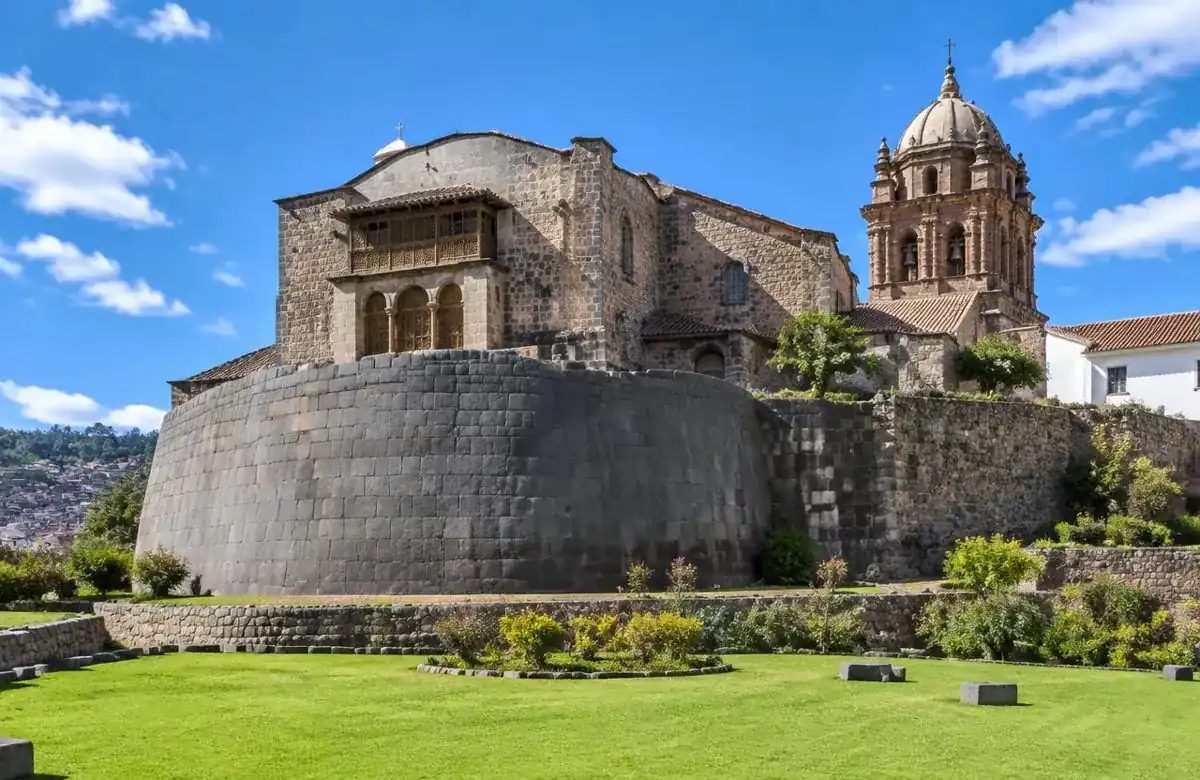
Qorikancha, also spelled Coricancha or Koricancha, was the most important temple of the Inca Empire, dedicated to the sun god Inti in the heart of Cusco. Its name means golden enclosure, because its walls were once covered in gold sheets. Today its fine Inca stonework survives beneath the colonial Church and Convent of Santo Domingo.
- Other spellings
- Coricancha, Koricancha, Quri Kancha
- Meaning
- Golden enclosure or golden temple
- Location
- Avenida El Sol, central Cusco
- Dedicated to
- Inti, the Inca sun god
- Built over by
- Church and Convent of Santo Domingo
- Time needed
- About 1 to 1.5 hours
What Was Qorikancha?
Qorikancha was the main religious center of the Inca Empire, originally called Intikancha or Inti Wasi, the house of the sun. Priests performed rituals here for Inti and other deities, and the temple stood at the symbolic center of Cusco, from which lines called ceques radiated across the empire to shrines.
The complex had several shrines around a courtyard, dedicated to the sun, moon, stars, thunder and the rainbow. Spanish chroniclers said a golden garden with life-size gold and silver plants and animals stood beside it.
Qorikancha is easy to combine with nearby sights; locate them on our Cusco map for first-time visitors, plan your day with things to do in Cusco and compare it with Machu Picchu's Temple of the Sun. The city's wider story is in our Cusco Peru travel guide, and the empire's record keeping is explained in what a quipu is.
Who Built Qorikancha, and What Happened to Its Gold?
The Inca ruler Pachacuti rebuilt Qorikancha in the 15th century, enriching it with gold plates and new shrines, on the site of an earlier temple. After the Spanish arrived in 1533, much of the gold was stripped and melted down, partly to pay Atahualpa's ransom, and the temple was given to the Dominican order.
The Dominicans built their church and convent on the Inca walls. Earthquakes in 1650 and 1950 brought down colonial structures, while the precisely fitted Inca walls beneath largely survived, revealing more of the temple after restoration.
Why Is Qorikancha's Stonework So Famous?
Qorikancha's stonework is famous as the finest Inca masonry anywhere. The Incas used ashlar construction: carefully cut rectangular blocks laid in even courses and fitted so tightly that no mortar was used. Walls lean slightly inward and use trapezoid doors and niches, features that helped them survive major earthquakes better than the colonial buildings above.
Look for the curved outer wall facing Avenida El Sol, a perfectly fitted semicircle beneath the church apse. Compare it with the cyclopean style of Sacsayhuamán's fortress walls, where giant irregular stones were used instead.
What Can You See Inside Qorikancha Today?
Inside Qorikancha today you can see restored Inca shrine rooms believed to be the temples of the moon, stars, thunder and rainbow, trapezoid niches and doorways, the colonial cloister of Santo Domingo with religious paintings, and gardens below the curved wall where the golden garden is said to have stood.
- Inca shrine chambers around the cloister.
- Trapezoid niches that once held sacred objects.
- Colonial cloister with arches and Cusco School paintings.
- Curved Inca wall seen from the gardens.
- Viewpoints toward Avenida El Sol and the city.
A separate underground site museum below the gardens is included on the Cusco Tourist Ticket rather than the convent ticket.
How Much Is the Qorikancha Entrance Fee?
The Qorikancha temple and Santo Domingo convent charge their own entrance fee, separate from the Cusco Tourist Ticket, reported at about S/15 to S/20 for foreign adults. The convent is typically open Monday to Saturday from about 8:30 am to 5:30 pm, with shorter Sunday afternoon hours. Confirm on arrival, as hours change.
| Part | Ticket | Reported cost |
|---|---|---|
| Qorikancha temple and convent | Separate entry at gate | About S/15 to S/20 |
| Qorikancha site museum | Cusco Tourist Ticket | Included in pass |
| Guided visit | Guides at entrance | Agreed price |
| Sunday visit | Separate entry | Afternoon only, reported |
How Is Qorikancha Different From Machu Picchu's Temple of the Sun?
Qorikancha in Cusco and the Temple of the Sun at Machu Picchu are separate temples. Qorikancha was the empire's main sun temple in the capital, later built over by a church. Machu Picchu's version, the Torreón, is a curved tower over a cave at the citadel, roughly 50 miles away.
Both share the curved wall design and sun worship. Read about the Machu Picchu temple in our Temple of the Sun guide.
| Feature | Qorikancha | Temple of the Sun, Machu Picchu |
|---|---|---|
| Location | Central Cusco | Machu Picchu citadel |
| Role | Main temple of the empire | Ceremonial and astronomical tower |
| Today | Under Santo Domingo church | Viewed from Machu Picchu circuits |
| Ticket | Separate convent fee | Machu Picchu ticket |
How Do You Plan a Visit to Qorikancha?
Plan a visit to Qorikancha on your first or second day in Cusco, since it is a short flat walk of about 5 to 10 minutes from the Plaza de Armas along Avenida El Sol. Go early in the morning for fewer groups, hire a guide at the door, and combine it with the cathedral and San Blas.
Alongside this Qorikancha, Cusco guide, if you would rather not plan every piece yourself, see our Machu Picchu vacation packages.
- Walk down Calle Loreto or Avenida El Sol from the Plaza de Armas.
- Buy your entry at the convent gate, in cash.
- Hire a licensed guide if you want the full story.
- Tour the shrine rooms and cloister for about an hour.
- Visit the gardens and curved wall.
- Use the Cusco Tourist Ticket for the underground museum.
Qorikancha is an easy, low-effort visit while your body adjusts; see our Cusco altitude guide.
Frequently asked questions
How do you spell Qorikancha?
Qorikancha is spelled several ways because Quechua had no written alphabet before the Spanish. Common spellings are Qorikancha, Coricancha, Koricancha and Quri Kancha. All refer to the same Inca temple in Cusco, and signs in Cusco use more than one version.
Is Qorikancha worth visiting?
Qorikancha is worth visiting for the finest Inca stonework in Cusco and the striking contrast of an Inca temple beneath a Spanish church. It is central, flat and takes about an hour, making it ideal for an acclimatization day. A guide adds much of the value.
Was Qorikancha really covered in gold?
Spanish chroniclers wrote that Qorikancha's walls were lined with gold sheets and that a garden of gold and silver objects stood nearby. Most of this gold was removed and melted down by the Spanish in the 1530s. Holes in some stones may have held fastenings for these plates.
Can you take photos inside Qorikancha?
Photos are generally allowed in the Inca areas and cloister of Qorikancha, but flash and photography of some religious paintings may be restricted to protect them. Follow posted signs and staff instructions. Tripods, selfie sticks and drones are usually not permitted inside the convent.
How old is Qorikancha?
The Qorikancha visitors see today dates mainly from the 15th century, when the Inca ruler Pachacuti rebuilt it, but an earlier temple stood on the site. The Santo Domingo church above was rebuilt after the 1650 earthquake, so the complex mixes Inca and colonial periods.
Want Qorikancha on your Cusco day?
Tell us your dates and we will plan an easy Cusco day with Qorikancha before your Machu Picchu trip. Prefer to read first? Get the free Machu Picchu trip guide.
Sources checked October 3, 2026
Recommended tours
Packages · 7 days
Machu Picchu Vacation Packages, 3, 5 and 7 Days
3, 5 or 7 days from Cusco with hotels, trains, Machu Picchu tickets and guides arranged. From $479.
from $1290
View tour →
Machu Picchu · 1 day
Machu Picchu Day Trip from Cusco
Train, bus, entry ticket and guided tour of Machu Picchu in one easy day from Cusco.
from $379
View tour →Keep planning
- Aguas Calientes Hotels: Where to Stay in Machu Picchu Town and How to Choose
- Aguas Calientes Hot Springs: A Practical Guide to the Thermal Baths Below Machu Picchu
- Ollantaytambo: The Inca Fortress Town of the Sacred Valley Explained
- Sacsayhuamán: The Megalithic Inca Fortress Above Cusco Explained
- Maras Salt Mines: How the Salineras de Maras Work and How to Visit
- Moray Ruins: The Inca Circular Terraces of the Sacred Valley Explained
- Pisac Ruins: The Inca Citadel and Market Town of the Sacred Valley
- Things to Do in Cusco: The Best Sights, Day Trips and Local Food